Saturday, September 4, 2021

The Graveyard at Donohill


     As a member of the group, Ireland Reaching Out, I receive regular newsletters from them in my e-mailbox.  One communication in April contained a fascinating discussion of Irish graveyards. The article noted among other things, ancestral burial grounds are the holy grail and finding yours is a huge accomplishment; it also reminded researchers not to underestimate the importance the Catholic Irish placed on being buried with their kin. Even if the death occurred in a different parish it was common for the deceased to be brought "home" for burial; and notably, this held true even if those kin were interred in a protestant graveyard.  Some of those ancient parish burial grounds had come under control of the Church of Ireland during the reformation and penal times; however, being buried with one's family far outweighed the importance of the burial place.  That could actually be helpful to researchers I would think, as protestants were much more likely to have kept burial records for us to find.

     But how, I wondered, could a graveyard have been in use for centuries and not be enormous?  An article online answered that question.  The graves were reused.  When a family member passed away the grave would be reopened for them.  In the 19th century laws were passed that limited this practice, but no doubt it continued albeit at a lesser rate.

       Recently, completely by accident, I may have stumbled upon my O'Dwyer ancestor's burial ground in County Tipperary.  I was attempting to get a look at Churchfield in the Parish of Donohill, on Google Maps, but the site wouldn't allow me to set the wee street view person down in that place.  The village of Donohill was the closest I could get, so I landed there and took a stroll down Davis Street, inching my way closer to Churchfield on the map. When directly across from Churchfield I turned the "person" and looked across the fields towards it.  There upon a rise was a large graveyard!  That's me on Davis Street down in the bottom left corner.  The red balloon on the map is Churchfield.

     I was not expecting that. I quickly opened another window to do a search for "Donohill Graveyard" and found that the place was an historic landmark located on the lands of Churchfield, but surprisingly little else, next to nothing in fact.  I'm not even sure it was designated a landmark because of it's antiquity or because Daniel Breen, leader of the Third Tipperary Brigade and considered the man who fired the first shot in the War of Independence in 1919, was buried there.  A photo online shows the remains of vegetation shrouded walls in the middle of the graveyard, making it appear to be quite old, it once may have been a church yard.  The Tithe Applotment Books actually refer to the place as "Church field of Donohill".  I find it odd there isn't more information available online about the place.  Not even Google Books has much.

     In looking at the old 6 inch OSI map of Churchfield from about 1830, my suspicions about a church yard were confirmed as was the supposition the burial spot was very old.  On this map the grave yard can be seen delineated from the church with the words, "in ruins", next to it.  Even at that early date there was nothing left but remnants of the church.  Above it on the map can be seen St. James' Well, a vestige from pagan times, converted after the coming of Christianity to a sort of shrine to St. James the Apostle.  Pattern day at this well was 27 July, when the faithful gathered there with Mass sometimes being said.  In my mind's eye I can see the O'Dwyer family walking the short distance to the well, gathering there with their neighbors to recite a Gaelic prayer to St. James.

     Of course, without knowing where my fourth-great-grandfather Andrew O'Dwyer was born I can't say this is positively the long lost burial ground of my O'Dwyers though it could well be given it's age and location.  All I know for certain is that Andrew's daughter Alice, my third-great-grandmother, was living in Churchfield in 1824 when she married Cornelius Ryan and that there were other O'Dwyers there as well, Jeremiah, Timothy, and Andrew, as shown in Griffith's Valuation.  Andrew in the Valuation may be Alice's father or her brother Andrew Jr.  The best bet I've found for Andrew Sr. in the earlier Tithe Applotments is an Andrew Dwyer living in Silverhill, about a mile and a half south of Churchfield.  In Churchfield itself, Timothy, Darby (being a variation of Jeremiah), and John Dwyer appear in the Applotment Books.  Perhaps Andrew had left Churchfield to find work nearby, ending up in Silverhill, and Donohill Graveyard, so close, is indeed the right spot?


Wednesday, September 1, 2021

What Was the Relationship? In Which a Pugilist Breathes His Last and a Family Disappears


Bridget Hogan Ryan (1834-1902)

     The Hogans; I don't want to call them a thorn in my side, but...  My third-great-grandfather Cornelius Ryan and his son Con Jr., from the Tipperary parish of Anacarty/Donohill, both lie buried in Darby Hogan's family plot at St. Anne's Cemetery in Palmyra, New York.  Why is that?  Cornelius Sr.'s older son Andrew Ryan married a woman named Bridget Hogan from Knockavilla, Tipperary though her father was Thomas Hogan, not Darby who lived far away on the other side of Tipperary.  Was Darby a brother of Thomas?  What was Darby's tie to the Ryan family, was it Bridget's marriage?  I can't say, and so I continue tracking the Hogans looking for that elusive link.  

     I'm currently researching the descendants of Thomas Hogan and Catherine O'Dwyer, parents of several Hogans who left Tipperary and settled in Wayne and Monroe counties in upstate New York.  That much I'm sure of since Bridget's marriage record contained her parent's names.  There's also that naming pattern that confirms it further.  Bridget had a brother named Michael Hogan who was a witness at her marriage to Andrew in Palmyra.  Michael married Mary Dolan and lived close to Bridget and Andrew in Perinton, New York near Palmyra.  Bridget also had a sister, Catherine Hogan, who married fellow Irish immigrant William Slattery at Palmyra.  Their marriage, while cut short by Catherine's untimely death three years later, did produce a son, Timothy Slattery, named for William's father. Catherine's is the only Irish baptism I've found, (this parish's records don't begin until 1835), and it names Thomas Hogan and Catherine O'Dwyer as her parents with their address as Knockavilla.  There are three others I believe were brothers of Bridget, Michael, and Catherine, though the links are somewhat tenuous.

    The oldest would have been James Hogan who in 1860 was married and living in Galen near Clyde, New York, about twenty miles from Palmyra. There are several indications James was a brother, the first being his only son was named Thomas, as was Bridget's second son, and Michael's first son.  Secondly, a newspaper article noted James' son Thomas worked at a glass factory in Muncie Indiana, the importance of which you will see in just a minute.

     Another probable brother was Peter Hogan who was two names from James in the 1870 census of Galen.  He and James were both railroad workers according to that census which may explain how they wound up in Galen. Peter died in 1875 at about age forty, afterwards his wife Ellen married the widower, Michael Carroll.  Peter's son, another Thomas, died from consumption at his mother's home in the spring of 1902.  His obituary read: "Thomas Hogan, the pugilist who died in Clyde Monday night of consumption, is said to have relatives living in Perinton. Mr. Hogan had been employed for the past year at the Muncie Ind. Glass Works."  The clear implication being, this Thomas and his cousin Thomas both worked in the glass industry in Muncie and the relatives in Perinton, mentioned in the obituary, would have been the deceased's father Peter's two siblings Bridget and Michael.  In one of those strange twists of fate, Michael Hogan in Perinton lost his own son Thomas six months later when the young man fell into the Erie Canal there and drowned.

     William Hogan is the individual I have the least information on.  He lived closest to Bridget and Michael and was a baptismal sponsor for one of their children.  William appears in the Palmyra census of 1870 along with his wife Mary and children Thomas and Sarah.  A burial record at St. Anne's in Palmyra memorializes, "Mary Lawler wife of William Hogan", who was buried 30 August 1874.  The 1880 census shows the widower William Hogan still in Palmyra with his children Thomas 25 and Mary 23.  After that year they simply vanish, I've never found another trace of any of them.  Sarah may well have married and changed her last name, but she, William or Thomas should have left some trace.  In years of searching however, I have not found that trace.

    Returning to Catherine Hogan who married William Slattery, it should be noted that after her death William married again.  This time to Sarah Ryan, none other than the daughter of Cornelius Ryan Sr., interred in Darby Hogan's cemetery plot.  And who do you suppose William Slattery's parents were?  Timothy Slattery and Johanna Hogan.  Another Hogan!  As if the four Thomas Hogans weren't enough.  It would seem I have come full circle and ended up where I began.

     The Slattery family is interesting not just for Johanna Hogan, but because it appears they had roots in Knockgorman, Tipperary, part of the very same parish Cornelius Ryan lived in.  I found baptisms for three of the Slattery children in parish registers, Sarah in 1822, Julia in 1825, and Timothy Jr. in 1832.  Timothy Jr. would later turn up near William in Palmyra as a young adult.  The one baptism I didnt find was William's, who married Catherine Hogan and Sarah Ryan. However, after playing with the search engine at Find My Past I came up with the following baptism in 1828 at Anacarty/Donohill;

 "Wm of Tim ??? & Judy Hogan, the address was Knockgorman.  FMP thinks Tim's surname is Mathew, I'm not so sure.  It could just as easily be the letters SL as the letter M beginning that name. The image below shows how the parish priest formed the letters M and the letter S in his abbreviation for Sponsors.  The man was S challenged.  To top it off, one of this William's sponsors was Patt Heffernan -- all the other Slattery children had a Heffernan as their sponsor too.  I'm not ready to rule this out as William's baptism just yet.

     Knockgorman was less than two miles from Churchfield where Cornelius Ryan was living when he married Alice O'Dyer in 1824.  These two families, the Slatterys and Ryans, knew each other in Ireland, but the question remains, did they know Darby fifty miles away in Killeen?

Tuesday, August 10, 2021

A Close Look at Those Cousins


     After decades of researching my direct ancestors, I'm able say most of their records currently online have been found; believe me, I try searching but lately it comes to naught.  Thanks in large part to the pandemic not many new records are being uploaded, forcing me to spend time on distant relatives whose information I haven't yet exhausted, if I want to do any research at all.  And I certainly do!  Today found me looking at the children of Daniel McGarr from County Kildare.  Not my 3rd-great-grandfather Daniel McGarr, but his cousin with whom he shared the same name.  They lived in the same area of Ireland, around Rathvilly and Ballyraggan, undoubtedly knew each other, and were close in age; but while my Daniel remained in Ireland, his cousin sailed off to America, settling near Auburn, New York.

     I've written before about three of Daniel's daughters who became nuns and have found birth and death dates for all nine of his children apart from Sarah who was born in Auburn in 1847 and was raised in nearby Owasco, New York, where Daniel established a large farm which was quite prosperous.  Sarah had proven elusive the last time I looked at her but perhaps today was the day I'd discover her story and hopefully by extension, more about her father.

     I had Sarah's husband in my tree as James Bryan and a date of 1926 for her death in Essex New Jersey.  I had however, neglected to add where I found the New Jersey information.  I almost deleted it; I could think of no reason why she would have been in New Jersey.  Then again, I must have had a reason when I entered it, so I decided to look further first.  Ancestry had a social security record for an Anastacia Mee, whose parents were James Bryan and Sarah McGarr.  That made sense, Sarah's mother was Anastacia Lyons.  Mrs. Mee lived in Minnesota though, far from Cayuga County New York, I wasn't positive I had the right person.  I tried doing a search for Sarah McGarr Bryan from her Ancestry page in my tree but that didn't get me anywhere.  I find that happens a lot.  A search done from scratch will bring up records, while one done using the "Search on Ancestry" tab on the subject's page misses them.

     A visit to the Cayuga County GenWeb site yielded Sarah McGarr's marriage to James Bryan at St. Mary's in Auburn in 1872, and after much searching some census records came to light.  One would think a name like Sarah Bryan would not be hard to find, but the 1900 census mangled it to, "Sirah Beyan", which Ancestry couldn't find until I tried a more creative path, searching instead for her son James Jr., who turned out to be a law student, using only his first name, birth year, and his residence as Cayuga County.  Then I could just scan down the list of hits till finding a surname that in another iteration could have been Bryan.  Ancestry didn't come up with a hit for Sarah in the 1880 census either until I employed those creative tactics. Sarah's husband did not appear in the 1900 census, although I found him in New York's 1892 census.  Using that to narrow the date of his death he was located in the New York State Death Index with a date of 19 February 1898. 

     I checked St. Joseph's Cemetery site in Auburn, looking for a James Bryan buried in 1898 and found him along with the section and lot number of his grave.  In the same place was buried his son Daniel Bryan and two other James Bryans.  One of them died in 1905 at age 10 months, (who I later found was his grandson), the other in 1932.  The second one must be James Jr. I reasoned, so a search for some obituaries was in order.  I found a notice placed in a Auburn newspaper in 1898 by a fraternal organization extending condolences to the Bryan family on the death of their patriarch, but nothing more.  The 1932 obituary, however, was the jackpot!  It read--
   One of Rochester's best-known attorneys, James S. Bryan, died unexpectedly yesterday afternoon at his home 1011 Highland Avenue.  He was 54 years old.
Last winter Mr. Bryan suffered a stroke and was confined to Strong Memorial Hospital and his home for several months.  He was apparently on the road to recovery and had resumed his law practice...  
   Mr. Bryan was born in Auburn, the son of James and Sarah Bryan and received his early education in St. Mary's parochial school and Auburn High School.  He was a graduate of Fairfield Military Academy and Albany Law School.  Shortly after his admission to the bar in 1904, Mr. Bryan formed a law partnership at Auburn with his brother Joseph W. Bryan, now a practicing attorney at New Rochelle, NY.  In 1912 he moved to East Rochester, where he established offices...

     The obituary proved his parent's names and revealed the law student had become an attorney, as had his younger brother Joseph.  But there were more goodies in this announcement--

   He leaves his wife Margaret C., daughter Mrs. James T. Hall, and son Thomas; two brothers, Joseph of New Rochelle and Dr. J.P. Bryan of Jersey City; two sisters Mrs. Francis Mee of Minneapolis and Sister Stanislaus Sister of Saint Joseph in Rochester, and a granddaughter. Funeral Friday morning at the home with burial in Auburn.

     This obituary really pulled it all together.  It explained why Sarah McGarr Bryan had passed away in New Jersey where her son the doctor was living, it proved Anastacia Mee in Minnisota was indeed his sister, and confirmed he was one of the James Bryans in St. Joseph's Cemetery.  It also gave the names of his wife and children.  A search of census records in New Jersey showed Sarah living with her son John T. and another son Francis, both were chiropractic doctors.  Most of my ancestors were farmers and didn't get the sort of obituaries Attorney Bryan did, but it certainly is wonderful when it happens.

     I sat down a few hours ago thinking I would perhaps find a few dates and spouses and instead wound up with another family story.  Best of all, I found something I never dreamed of finding, that most coveted family treasure of all, a photograph!  Below, from his passport, is Dr. John Theodore Bryan--

John T. Bryan

       The passport made fascinating reading, it confirmed all the information I'd already collected for this family and stated the reason John was going abroad.  The purpose of his trip to France and Great Britain was war relief, under the aegis of the Knights of Columbus, that charitable, fraternal, Catholic organization.   

     And then, another photo came to light; this one is of James S. Bryan the lawyer, from his obituary--

     Neither photo of the brothers is a very good image, but I'll take them.  John's passport even gave the birthplace of his father.  Not just "Ireland" as is usually the case, but a real place, Monavothe, Rathvilly, Carlow, Ireland!  James Bryan Sr. was from the same vicinity as the McGarrs.  As I've been investigating these far-flung relatives lately, I've found myself enjoying it much more than I thought I would--that flash of recognition when I realize the name of a newly found spouse is already somewhere in my tree.  It's been fascinating to see my cousins from different parts of Ireland meeting and inter-marrying in America and their children doing the same, my tree branches are beginning to cross.  I love discovering others in their adopted neighborhoods in America who were unrelated, but from the same townlands and parishes in Ireland and had known each other in the old country, long before they arrived in New York.  Maybe being reduced to studying distant relatives isn't so bad after all.


Thursday, July 22, 2021

Finding Hattie/ In Which An Obscure Poetry Site Yields An Answer And A Tombstone Disappears


     Eighteen forty-nine was a cholera year.  From Ireland, where nearly 600 people perished in Ballinasloe workhouse in a single week, to Europe and America, the pandemic immured the world in misery.  A dangerous, highly contagious disease, Asiatic cholera first arrived in the United States at port cities like New York and New Orleans, rapidly spreading death along inland waterways and the burgeoning railway system.  Desperate communities were easy pickings for swindlers promising cures and preventatives.  In the spring of 1849 at Rochester, New York, a Mr. M. O'Brien was manufacturing something he called, "Cholera Candy", while Dr. Ripley was hawking a vegetable compound claimed to be infallible if taken in the first stages of illness.

     Not far from Rochester, the town of Phelps, New York lay between Flint Creek and the Canandaigua Outlet making it prime mill property.  It's location near the two waterways also made it prime property for numbers of travelers to be passing through.  My third-great-grandfather Russell Galloway operated a grist mill in that place during the late 1840's.  He and his wife Harriet B. Moore arrived in Phelps from Wolcott, New York sometime around 1845, settling on the banks of the outlet with their family.

     In researching the Galloways, I came across a site containing inventories of cemeteries in Ontario County of which Phelps is a part.  I was surprised to see listed in Pioneer Cemetery in the village of Phelps, Harriet P. Galloway, daughter of R and H B, aged 2 years.  Without that information I would never have known of little Hattie's existence; being born in 1847 and passing away in 1849 meant she was not enumerated in any census.  I have an aunt who lives a block from Pioneer Cemetery, so we set out one hot, humid day to find Hattie.

     Pioneer is not a large cemetery so we split up and did our best, but we could not locate the grave.  Discouraged, we walked back to my aunt's home to cool off and plan our next steps.  We called the village clerk who informed us the cemetery was cared for by the town.  The town had no maps of burials, but they too began searching other records and lo and behold, found a photograph of the stone, not in their files, not on a cemetery site, not on a genealogy or history site, but on one called Poetrex.  A poetry site.
     
Harriet P. Galloway died May 18 1849 2 yrs 2 mo 21 days

     That photograph left us puzzled, the inscription appeared so deep and clear.  How on earth did we not find it?  Reinvigorated by this new information, (and a glass of chilled prosecco), we returned to the cemetery confident we would locate it this time, but the results were the same as before.  Retreating once again to my aunt's air conditioning we studied the photo for clues.  There weren't many.  A few fallen leaves near the stone gave some perspective as to its size and at the top, part of a small flag decorating another grave could be seen in the background, that was about all.  After enlarging the photo for a closer look, it became apparent those white marks near the bottom were in fact gashes, the base was quite damaged.  It appears the stone was originally white, and now I wonder if it didn't topple at some point.

     While disappointed that I may never know where Hattie rests, at least there is a photograph of her tombstone.  I also don't know if Hattie was a victim of the cholera epidemic raging in New York that May of her death, but I think there is a fair chance she was.  I plan to make one more trip to the cemetery, on a cool day, to check for fallen stones but even if I don't find her, Hattie's all too brief life is recorded, she is not forgotten.


Sunday, July 18, 2021

Beware False Prophets or There's One Born Every Minute


Jesse James Strang

     The place was Beaver Island, largest of several that lay in the northernmost reaches of Lake Michigan, the year 1856.  In this lovely spot a murder was about to take place, though there were more than a few who would consider the man's death divine vengeance.

     Who was this man, why did he come to his violent end here, far from his birthplace?  His story began over six hundred miles away in Cayuga County, New York in 1813, the Town of Scipio to be exact.  Later he and his parents Clement Strang and Abigail James would relocate to Chautauqua County in the same state.   Clement Strang was the grandson of my 5th great-grandaunt Antje Clement and her husband Gabriel Strang.  Antje's father Johannis Clement was my 6th great-grandfather making the victim my 3rd cousin 4 times removed.

      His given name was Jesse James Strang, though later in life he would reverse those names to become James Jesse Strang, the king of Beaver Island.  The next step in this curious tale was the chance meeting in Illinois between James Strang, who had fled his creditors in New York, and Mormon prophet Joseph Smith.  Not long after, Smith was assassinated by an anti-Mormon mob and James, ever the opportunist, saw his chance.  He forged a letter naming himself as Smith's chosen heir to lead the new faith, signing it with Smith's name. This so enraged the other contender for the job, Brigham Young, that after winning the leadership Young promptly excommunicated James.  Not to be deterred, James took his wife and children further west to Wisconsin where he set about building his own religious utopia he named Voree. 

     The place prospered but James believed it was still too close to the gentiles, as he called non-Mormons.  With the lynching of Joseph Smith still fresh in his mind James looked about and happened upon Beaver Island, telling his followers he had seen it in a vision.  The group began the move to that place though they had no legal claim to the land which was then populated by a few Native Americans and some white fishermen and their families, many of them Irish.  Things went well on the island for a time, the town grew with new members arriving regularly, but James was not yet satisfied.  Now he must be king.  Somehow, James convinced his followers that his edicts were revelations from God himself.  In 1850, after one of these revelations, while wearing red robes and a paper crown decorated with golden tinsel stars, James Strang had himself crowned king by his adherents in a farcical ritual devised by one of the group who was a former actor.

     Had James in fact been the benevolent leader he proclaimed himself to be, he might have lived out his days in comfort and peace, but as often happens, power went straight to his head.  Among the unpopular revelations he now began to receive was the requirement that women wear bloomers instead of long skirts, the introduction of animal sacrifice, and most unpopular of all, the institution of polygamy even though he had perviously been against it.  James himself aquired four new wives, initially going about it quietly.  He traveled frequently, looking for new recruits, and on one of these trips he was joined by his nephew Charles James Douglas.  Many of those who met Charles sensed something was off about the young man, it was not long before the jig was up.  Charles was in fact Elvira Field who had become James' second wife on Beaver Island, now dressing in men's clothing and cropping her hair in an attempt to avoid scandal while traveling alone with him.

Elvira Field dressed as a man

     As James steadily devolved into a petty dictator, resentment against him grew.  Another teaching of his was the idea Mormons, being the rightful heirs of earth, were not constrained by property laws and were therefore entitled to take whatever they desired from gentiles.  As a result of depredations against their neighbors, anger was now growing outside the group as well as within. Eventually, other residents of the island had enough of being robbed and threatened; complaining to authorities they demanded action be taken.  In 1851 the federal warship Michigan approached the enclave, arrested James, and whisked him off to Detroit to stand trial, where he was acquitted.  Afterwards an unrepentant James returned to Beaver Island, taking up right where he had left off.  In 1856 the USS Michigan was forced to make a return voyage to that place where the following ensued on June 16th, 1856--

Capt. McBlair sent a messenger to Mr. Strang, requesting him to visit him on board.  Mr. Strang immediately accompanied the messenger, and just as they were stepping on the bridge leading to the pier, two assassins approached in the rear, unobserved by either of them, and fired upon Mr. Strang with pistols.  The first shot took effect upon the left side of the head, entering a little back of the top of the ear, and rebounding, passed out near the top of the head.  This shot brought him down, and he fell on his left side so that he saw the assassins, [Thomas Bedford and Alexander Wentworth former followers]... The assassins immediately fled on board the U.S. steamer, with pistols in hand, claiming her protection.—Northern Islander, June 20, 1856

     Though fatally wounded, James was conscious and supposedly requested he be taken to Voree where his estranged first wife Mary was living.  It was here he died on July 9th.*  Mary was not by his side, she being in Illinois visiting her brother.  Only two of his five wives, four of whom were pregnant, were present when James departed his earthly kingdom.  His assassins were never punished.

     I can't say why it it is, but it seems whenever I look closely at the non-Irish ancestors in my mother's side of the tree, weird things come to light.  Accused witches, clowns, spiritualists, bigamists, and now a self-proclaimed monarch all frolic among those twisted limbs.  I often wish I was able to tell her about them.


 * There is so much more known about this man and his life it would require a book, not a blog, to cover it all and indeed, several have been written.  Many articles are online, and a search of Google Books brings up a good number of pages as well.

Saturday, July 3, 2021

My Irish Native Americans


Emily Beane aka Obezaun

     Today as I was reviewing and entering information about the McGarr family into my Ancestry tree  I got a surprise.  It seems one of my McGarr line married a Native American.  Well, half native, but enough so that he and his siblings were listed in the Indian Census Rolls.  He even had a native name, Mah Koonce, to go along with his English name which was Truman Beane.  


     Truman was the son of an Englishman named Wallace Beane (1832-1899) and his Native American wife Emily Branley (1840-1915), whose native name was Obezaun.  She was a member of the Mississippi Band of Chippewas who in her later years lived at the Gull Lake Reservation.  I was initially confused by the Indian censuses but discovered that at least at Gull Lake, an individual did not have to be an actual resident of the reservation to be included in this census.  It seemed to actually be more of a head count of tribal members.  For instance, in 1900 Truman was listed on both the Federal and Indian censuses.  I also found the Beanes listed in a land allotment database.  The Nelson Act of 1889 established the allotment of American Indian lands to American Indians in Minnesota, enabling them to become landowners. The real goal however, was the removal of the Chippewa from their reservations with the "surplus land" being sold to white settlers and logging and mining companies.  Naturally, I was curious about all this, I had questions. After much reading things began to be clearer.

     Emily or Obezaun, the matriarch of this family, was born about 1840, probably near the shores of Gull Lake in Minnesota.  A tree online asserts her father was the handsome, charismatic leader, Chief Hole In The Day, but offers no proof of that.  Turning to one of my favorite sites, Google Books, I found a book called, The Assassination of Chief Hole In The Day.  It was filled with interesting information, and even named one of his children as, "Ohbezzum", that's pretty close to Obezaun.  It also said one of his wives was a white woman, reputedly Irish.  Unfortunately, the book also said three of his children, including Ohbezzum, died young.  Then I tried typing, Mah Koonce Bean, into Google's search box.  The first hit was a site with old genealogies of the White Earth Agency Native Americans!  There I found Obezaun's father was in fact, Ogahbaishcumoquay, her mother was Baydwayway.  So much for being the chief's daughter.

Obezaun and Wallace Beane

     But how did Obezaun get together with Wallace Beane from England in the first place?  Another book at Google helped explain that.  Wallace came to America and spent several years knocking around Illinois before moving west to St. Paul Minnesota, where he worked hauling merchandise from that place to the frontier beyond the city.  In 1856 Wallace moved his business to the Chippewa agency, most likely it was here that he crossed paths with O.  Yet another publication on Google Books recorded Wallace being paid for delivering oats to the Pillager and Lake Winnebagosh Chippewa bands.  He married Obezaun in 1859, several years after the birth of their first child Franklin, going on to have seven more, one of whom was Truman who married Mary O'Neil.  

     I wondered how Wallace and Obezaun's mixed marriage was viewed by their neighbors.  While there were probably some who looked askance at their union, it remains there were exactly three white women living in their area as late as 1866, none single, and such marriages were not uncommon.  Evidence of that can be seen in a report done in 2014 concerning eligibility requirements for tribal membership, determined by, "blood quantum".  One tribe member when asked his opinion on the current requirements in 2014 stated, "They should be lowered, they have a lot of us down as part Irish".

     But back to the McGarrs -- what was an Irish girl like Mary O'Neil, whose mother Eliza McGarr was the child of Irish immigrants, doing in the wilds of 19th century Minnesota?  That's a long story.  The short version is, Mary's father, Philip O'Neil, brought his wife Eliza McGarr and their four children to Iowa from New York, (their fifth, the above-mentioned Mary, was born in Iowa), at the same time Eliza's parents John McGarr and his wife Hannah Kilfoyle left the state in a bit of a hurry right after John was acquitted of murder.  After Eliza's untimely death at the age of thirty-one, Philip left Iowa under circumstances explained in still another tome -- "he stayed until 1878 when he was called away to the regret of his numerous creditors". You have to love Google Books.

     By the time of the 1900 census Philip was in Brainerd, Minnesota, living with his daughter Elizabeth O'Neil Breason and her family.  Mary O'Neil and her husband Truman Beane, aka Mah Koonce, whom she had married in 1889 in Crow Wing, Minnesota, were living in Brainerd as well.  Mary died that year of "heart trouble", as the newspaper put it, but the cemetery has a record of an infant born to her at the same time who also did not survive.  A sad fact of life in those days.  Her own mother, Eliza McGarr, may have suffered the same fate.  Her death came two years after Mary's birth, just when a new baby might have been expected to join the family.

     One of the many things I really love about doing family research is the fascinating history that comes with it.  I have learned so much about Irish and American history while seeking my own personal history.  And now a small bit of Native American history as well.


He's not Obezaun's father, but he's pretty handsome so I included his picture


Saturday, June 5, 2021

Destiny Summons


TB Sanatorium in Colorado 1906

    "Several of my ancestors died of tuberculosis, four that I'm aware of, but I'd be willing to bet there were others.  It's been estimated that by the 19th century, TB had killed one in seven of all people who had ever lived.  That's an astounding number.  One particularly heartbreaking case was that of my third great-grandmother Sarah Charlotte Fowler Vincent.  Sarah lived with her family in the rural community of Butler, New York.  She died at her home in the summer of 1883 when she was fifty years of age, eleven days after the death of her twenty-year-old daughter Mary Ann from the same disease.  Sarah left a husband and three other children none of whom, to my knowledge, ever developed TB."

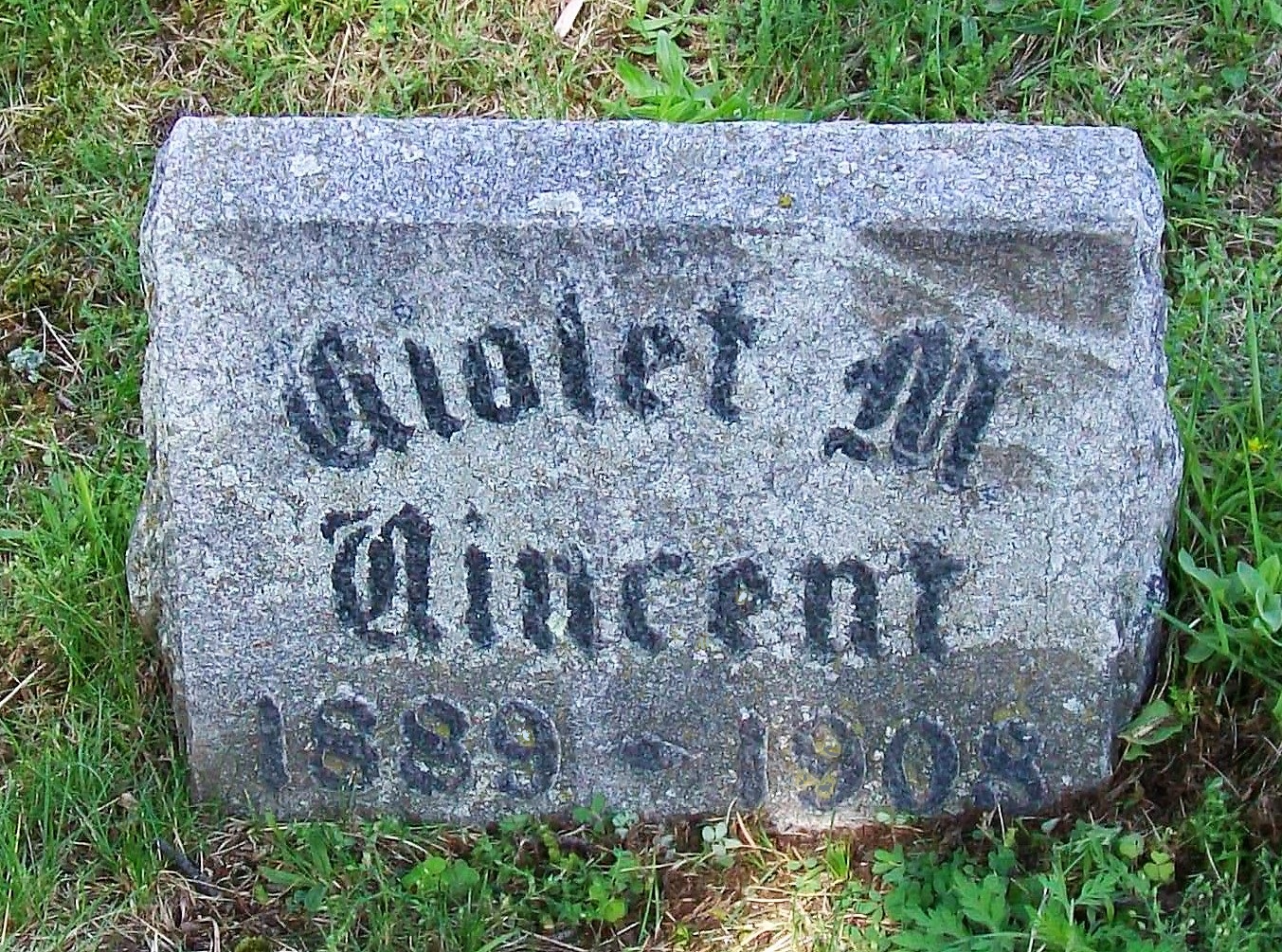
     I wrote those words in early November of 2015.  After years of research, I've found I would have won my bet that others in my family had died from tuberculosis, quite a few actually.  In fact, the last sentence in the above paragraph would prove tragically incorrect.  Thomas Edward Vincent, also known as Edward Thomas, was the second son of John Taylor Vincent and his wife, the above-mentioned Sarah Charlotte Fowler.  He was twenty-four when consumption killed his mother and his sister Mary Ann.  Thomas led a typical life after their passing, he married a young woman named Antoinette DeVoe and the couple set off to Indianapolis to begin their married life.  In 1889 they were blessed with a daughter, Violet Vincent, who was born in New York state.  They had clearly returned home before her birth.

     Local newspapers found no reason to publish any stories about the Vincents until 1893 when this appeared in the 12 October edition of The Lakeshore News:

 Thomas Vincent who returned from the west the last of June in feeble health, died at the home of his brother George Vincent in Butler on Tuesday.  The funeral will be held from the house Friday at 2 o'clock. Burial will be in Butler Center cemetery.

     The article doesn't specifically say the illness that killed Thomas was consumption, but the description of his feebleness and his returning from the west certainly hints at it.  During that time, fresh, dry air and high altitudes were believed beneficial to sufferers of consumption.  Thousands traveled west as a result, earning Colorado the nickname, "the world's sanitorium", due to the crowds of patients who flocked to that state for treatment.

     Things were beginning to make sense about this family.  I'd always wondered why Violet was an only child and why she lived with her maternal grandparents?  In New York's census done in 1892, three-year-old Violet was with them in Owasco, New York while her parents were nowhere to be found.  Of course, I now know they were likely somewhere in the west, in a state that didn't do a census in 1892.  

     Another question about this family also centered on Violet.  She died the 8th of June in 1908 at the age of eighteen, but the obituary I had for her did not give her cause of death.  Yesterday I did another search at a different newspaper site and found a different obituary:

Miss Violet Vincent died at the family home in Owasco at 2 o'clock Tuesday morning.  Miss Vincent was well known and highly esteemed both for the lovely characteristics she personified and as the daughter of Mrs. Antoinette Vincent.  Miss Vincent was but 18 years of age and was a victim of consumption.

      Twenty-five years after her grandmother Sarah Charlotte's death, tuberculosis still had this family in its evil grasp.  I can only imagine the terror that must have enveloped Antoinette as her daughter's symptoms first appeared, then steadily worsened.  She had watched, powerless, as her husband succumbed and she knew the same disease had taken his mother, this time her only child was its victim.  Even in 1908 there were no effective drugs to combat TB, their development was over thirty years away, so like her father, aunt, and grandmother before her, Violet endured the slow decline until her passing at the home of her grandparents.

     Antoinette later moved to nearby Auburn where she supported herself by teaching, she never remarried.  She died herself in 1933 at the age of 72.  Antoinette and her parents rest next to Violet in Soule Cemetery in Sennett, New York not far from Owasco.

     There are several cases in my family tree of one or both parents contracting TB while their children seemingly escape it only to be stricken years later.  The disease has the insidious ability to lie dormant inside the body only to flare up should the victim's immune system be compromised by stress, illness, or some other reason.  Thankfully, like many of the diseases our ancestors had to contend with, TB is not the death sentence it once was in most cases.