Saturday, April 13, 2013

Black Sheep Sunday / The End of "Big Ed" McCabe


Christmas Lights circa 1914
     The year was 1914.  While the pretty lakeside village of Canandaigua, New York was strung with garlands and lights twinkled in shop windows enticing Christmas shoppers, Edward McCabe and his roommate Thomas Burns were busily downing drinks in a village saloon.  Later the two men caught the train to the small hamlet where they resided.  Edward, the son of my second great-grandfather James O’Hora’s sister, was born in Auburn, New York to Irish immigrants Patrick and Mary O’Hora McCabe.  Now at 55, Edward was a large man, over 200 pounds, and in top shape from the physical labor he performed on area farms.  A news article described his physique as magnificent. Edward had a long arrest record, begun in his teenage years for petty robberies and assaults.  His friend Thomas Burns was an immigrant from Ireland, and at age 33 a younger and much smaller man than Edward.   Both were farm laborers and bachelors who enjoyed their liquor, and they brought with them on the train that day a jug of whiskey.

      Witnesses would later testify that after disembarking at the station in Holcomb, the men were overheard arguing loudly over who contributed more to their living expenses.  The two eventually returned to their shanty a short distance away and resumed drinking.  The argument continued off and on throughout the evening as the liquor flowed.  No doubt weary after the day’s exertions, Edward McCabe stretched out on his bed. Burns, still angry, took that opportunity to attack, unexpectedly striking Edward with a shovel using such force that the blow cut Edward’s nose and lips in two vertically, and left a jagged wound down his forehead.  He fell from his bed and lay helpless on the floor as Burns continued the assault, stomping and kicking him, breaking his ribs and inflicting internal injuries.
 
     Early the next morning, December 10th, Edward was found by two hunters, who upon hearing moans emanating from the shanty entered and found his bloodied form still lying on the floor next to the shovel.  He was rushed to Canandaigua and admitted to the hospital there where he made a deathbed statement detailing the attack and naming Thomas Burns as his assailant.  Edward died of his injuries in the early morning hours of December 11th. His death certificate gave the cause of death as,”Hemorrhage and shock due to lacerations of head, fracture of ribs and other injuries, probably homicidal”.
 
      Burns, who had returned to Canandaigua to continue imbibing, seemingly unaware of his roommate’s demise, was apprehended in a rented room at the Webster House there.  Charged with murder, he would later be allowed to plead guilty to manslaughter and was sentenced to, “at least six years and six months and no more than nineteen years at Auburn Prison”.  Edwards’s brothers from Auburn came for his body and accompanied him on his final trip home.

     Thomas Burns’ future is not clear.  In the 1930 census, the Utica State Hospital for the Insane had in their care a patient named Thomas Burns of the right age.  I can’t be certain it’s him, it’s a quite common name, but it well may be the right man.  The patient named Thomas was born in Ireland as was the killer Thomas, who at one time had lived in the Syracuse area.  He could have returned there after his release on the manslaughter charges; Utica is only an hour away from Syracuse. 

     Six and a half years seems a very short time for such a brutal murder, I can only wonder why he was allowed to plea bargain such a straightforward case and given the light sentence he was? 

Thursday, April 11, 2013

New Irish Database

   Quick post to let you know a new Irish emigrant database drawn from ship manifests has come online recently  at http://www.dunbrody.com/

    The site is sponsored by the Dunbrody Famine Ship and Irish Emigrant Experience, a tourist attraction in County Wexford featuring a reproduction of the original barque  Dunbrody that carried emigrants to America between 1846 and 1851.  Coincidentally, or perhaps not, those are the same years covered by the database, but it includes passengers traveling on other ships as well

      A nice feature on this site is the ability to search for a name and then, with a click of your mouse, opt to view a complete manifest to see who else may have been traveling with the person searched for.

Tuesday, April 9, 2013

Workday Wednesday / You Deserve A Break Today


     Sometimes I sit down at my desk, anxious to get on with my family research and nothing happens.  I sit staring at a blank computer screen trying to figure out what to do next, and not a thing comes to mind.  Every site I know of has been searched; every database scoured with the same results turning up over and over, now what?

     I’ll tell you what--take a break.  Not from genealogy research, God forbid!  Genealogy is what I do.  Instead, try researching the people who were living in the same neighborhood as your relatives.  Not just their history, take a look at what they were doing; what they were talking about, sort of a variation on the “friends and family” technique.   I suppose it’s closer to sociology than genealogy, but still interesting and relevant.  You may learn something about your ancestors by “going in the back door”.  You’ll certainly get a feel for what was going on in their community.

     For instance, Saturday I wrote about a group of my ancestors who left Ireland and settled in Farmington, NY.  They weren’t there alone; there was a whole group of Irish living there, (mostly from County Waterford), in an area referred to as the “prairie district”.   They didn’t live in a vacuum; they visited, formed friendships, fought and intermarried.  They gossiped too, and in 1899 you can bet the topic was the increasingly evident pregnancy of Mrs. Catherine Sexton, a pregnancy conceived while her   husband Edward Sexton was in jail on an assault charge.  Things got even more sensational when in 1903 Edward was put on trial for ambushing and murdering Thomas Mahaney; the man he believed had cuckolded him and fathered his wife’s child.  Found guilty, Edward was sent to the electric chair at Auburn.

     Searching the site Old Fulton Postcards http://fultonhistory.com/Fulton.html produced hundreds of articles about the trial and turned up earlier offences Edward had committed, beginning with his shooting a neighbor in the head at the tender age of eleven.   The neighbor survived, but the crime earned young Eddie a stay at the”Western House of Refuge”, which it turns out was one of the first facilities in the country for juvenile delinquents, and located in Rochester, NY.  The search also turned up this article about conditions in their Farmington neighborhood—“Persons acquainted with the prairie district say that many hard cider, alcohol and poor whiskey gangs are in full sway there and it cannot be described as a peaceful rural community”.  Another article made reference to the “prairie chicken gang”.  Now that’s information you can use.
     

     I learned other interesting things while delving into Edward Sexton’s sordid life.  I had long believed the Mahoney and Mahaney families in Farmington were actually the same family and that was borne out by details in articles about an earlier assault Sexton had made on one Maurice or Morris Mahaney, who I knew was a brother of my second great uncle Thomas Mahoney, (not to be confused with murder victim Thomas Mahaney).  The term “prairie district” was a new one on me as was the turbulent lifestyle of some of its residents.  I even found pictures of Edward and his victim Mahaney in a newspaper.  I wish I could turn up a few of my ancestors pictures, but somehow it always seems to be individuals on the periphery. 

    Something else about the murder absorbed me.  It was Edward Sexton’s uncanny resemblance to Mink Snopes, a character in William Faulkner’s novel The Hamlet.  From Edward’s wife’s infidelity, the murder from ambush and even his physical description, it’s like this case was the model on which Faulkner based his character.  Then too, the year Edward went to jail as a juvenile, his parents brazenly chose to name another of their sons Pliney Sexton, after the rich banker in a nearby village who coincidentally shared their surname—again, straight out of Faulkner.  But I digress…

     In closing, if you find yourself hitting walls and getting frustrated why not try a different approach.  Think of how excited you will be when in a month or so you resume your specific family research and a whole slew of new databases have come online.

Saturday, April 6, 2013

Surname Saturday / I've Got Ryans By The Number


     Ryans are the Smiths of Irish genealogy.  They were literally everywhere in Ireland, though Tipperary and Limerick had the highest concentrations, which is still the case.  The Irish Ancestors website has this to say about the family, “The vast majority of Ryans today are descended from the family of Ó Maoilriagháin, meaning descendant of a devotee of St. Riaghan”.  All I have to say is these people must have been shamelessly prolific.
 
     I have two Ryan lines in my family tree, neither is related to the other and they’re not even from the same county.  One hails from the Barony of Clanwilliam in South Tipperary where I’m told they were very important before Cromwell and his hordes arrived, the other from the Barony of Middlethird in County Waterford. 

      Tracing Ryans in no easy feat, especially given the old Irish penchant for reusing forenames.  I thought I had lucked out when I found my third great grandfather Cornelius Ryan.  An oddball name like Cornelius would surely level the playing field somewhat, but no, it’s a fairly common name in Ireland.  The Tipperary Family History researchers (http://www.tfhr.org/) were able to locate the family for me in Churchfield townland only because I had found US records indicating Cornelius’ wife and children’s names.  You really must do your homework in the US before thinking about Irish research, the more you know about your people the more likely you are to find them in Irish records.  It’s especially important when it’s a common family name like Ryan.

No that's not paint-I left the moss on that line for photographic purposes
     The other line was a little harder to trace… I had to do it myself.  They had married into my Power family who I knew were from somewhere in County Waterford, where you can’t throw a stone without hitting a Power. These Ryans weren’t really related to me, I was tracing them to hopefully determine a townland for the Power family.  My break came in the Catholic cemetery in Palmyra, NY where I located a grave stone for Mary Power (my second great grandfather’s sister) and her husband Thomas Ryan with the engraving, “Natives of Tramore” as you can see in the picture above. 

     I’ve been doing Irish genealogy long enough to know that when a record of any sort says Tramore or Tralee or anyplace else that you’ve actually heard of, it’s usually not the end of the story.  Nine times out of ten, Tramore is the parish not the townland.  You’re getting close, but not quite there yet.  When the Catholic Parish of Tramore records finally came online at IFHF (http://www.rootsireland.ie/ ) I found the Power’s real address, the townland of Cullen Castle, a few miles north of Tramore.

     By the late 19th century these Ryans and Powers, along with the Crotty family also from Cullen Castle, (one of whom, Honora, was my third great grandmother and mother to Mary Power Ryan above), had all relocated to the Town of Farmington in upstate New York; there was and is no Farmington village.  Even today the name fits perfectly, Farmington is mostly farmland.  There was a general store in a hamlet called Pumpkin Hook, (I swear I’m not making that up), but it’s been closed for decades.  The place still looks pretty much as it did when the Ryans, Powers and Crottys were roaming about and I kinda like that.

Thursday, April 4, 2013

John Ruddy Finally Goes Home


     One has only to glance through the database of missing persons at the website  Information Wanted (and I highly suggest you do) to see the large number of Irish immigrants who somehow lost touch with their friends and families during the desperate exodus of the famine years.  I’ve found it in my own research-- the will of an ancestor that read, “Son left for Detroit 20 years ago and not heard from since-presumed dead”, and the notice in a British paper seeking news of a brother of one my ancestors whose rumored death in St. Louis somehow filtered back to South Tipperary.

     Many of these unfortunate families were never reunited with their loved ones, or even learned their fates.  Now for one family the mystery has been solved albeit nearly 200 years late.  I’ve been following the story in the weekly newspaper “The Irish Echo” of the mysterious deaths in1832 of Irish rail workers in a Pennsylvania valley.  The mainstream press hasn’t seemed to give much coverage to this haunting story, but it’s one that fascinates me.

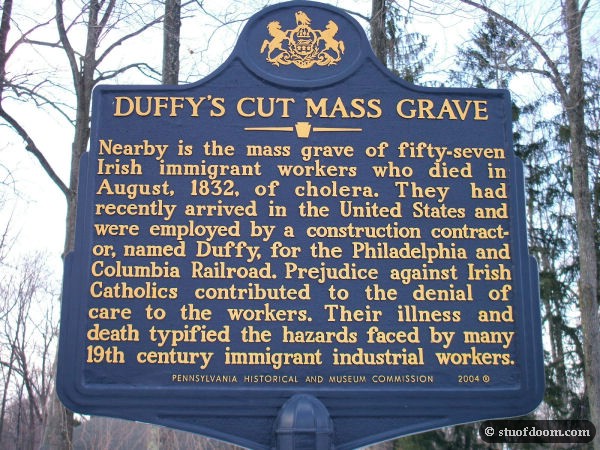
     Railroad development was just getting under way in 1830’s America.  In the decade between 1830 and 1840 over 2,000 miles of track would be laid, and as they had done in the building of the Erie Canal, entrepreneurs looking for cheap, expendable labor turned to Ireland.  In 1832, 57 men from County Donegal were recruited to work on the dangerous section of track that would come to be known as Duffy’s Cut.  They arrived on the Philadelphia docks in mid spring, and within 6 weeks they were dead.  Cholera was the cause given, and it was certainly present, but there was much more to the story.  Locals seemed to sense something terrible had happened in the labor camp. Cholera was a very serious disease, but it was not 100 percent fatal.  Even if untreated, some of the victims would have survived.  Stories circulated of ghosts dancing on their own graves, and then there was the unsettling way the railroad had hushed up the incident, to the point that relatives in Ireland were never notified of their loved ones deaths.

     It would not be until the 21st century that the facts slowly emerged.  It began with the discovery of a secret file detailing how the railroad had covered up the deaths.  Included in the file were directions from a later railroad president that a marker should be built for the men, and further instructions that the file should never be made public, indeed should never leave his office.  After its discovery, excavations began and the site of the labor camp was unearthed, but aside from some artifacts nothing else came to light for over four years.  Then in 2009 two sets of remains were found, one them of a teenager, and what they told investigators was unnerving.  Both had holes in their skulls, hardly a symptom of cholera.  Forensic examination of the bones also revealed the hard life these men had led; young though they were, their joints were worn down with heavy labor and lifting and showed signs of various illnesses.
 
      Using ship passenger records, (there was only one 18 year old on the ship), and DNA along with a genetic dental anomaly that still runs in the family today, researchers were able to give a name to the young victim—John Ruddy.  The first weekend in March he was reburied in his native County Donegal.    Four more sets of remains were discovered, and there are still more buried at Duffy’s Cut, some so close to the active rail line they may never be disinterred.  The additional remains were laid to rest in Pennsylvania under a Celtic Cross of Irish limestone.  It’s a small comfort that at least one of those men got to go home.

     To learn more about this project, try this Smithsonian site which has 3 short videos, http://www.smithsonianchannel.com/site/sn/show.do?show=131088 or listen to the very interesting 2009 interview with researchers on MP3 at this site Radiotimes
     Also, watch for the PBS special, scheduled to air on May 8th at 10 pm.